Subir MahapatraPresident of Global Strategy, Sales, and Marketing, Denave
“A Leadership Conversation on AI, Sales Intelligence, and the Rise of Agentic Demand Generation” |
Enterprise revenue teams are at an inflection point unlike any seen in decades. IDC projects global AI spending will reach $632 billion by 2028, while McKinsey estimates that generative AI could unlock up to $1.2 trillion in additional productivity across sales and marketing. Yet despite these surging investments, confidence in predictable, sustainable growth remains elusive.
The uncomfortable truth is this: more data, more automation, and more pipeline activity are not, on their own, translating into better commercial outcomes. The gap between investment and impact is growing, and enterprise leaders know it.
In this conversation, Subir Mahapatra, President of Global Strategy, Sales, and Marketing at Denave, shares his perspective on how AI, Sales Intelligence, and Agentic Demand Generation are fundamentally changing how enterprises grow—and why execution, not just technology, remains the defining advantage.
AI is now central to every boardroom conversation. What does this shift actually mean for enterprise revenue teams?
The honest answer is that most organizations are still catching up to what AI actually means for revenue execution, not just productivity.
For years, Demand Generation was measured by activity: how many clicks, MQLs, downloads, or registrations. But enterprise buying has become structurally more complex. A single b2b deal today typically involves 6 to 10 stakeholders, each with different priorities and different points in their decision journey.
At the same time, Gartner has reported that 67% of B2B buyers now prefer a largely rep-free buying experience. That means the majority of enterprise buying decisions are being shaped before a sales conversation ever begins.
Demand Generation has existed for decades. Why is the agentic era forcing enterprises to rethink it now?
It is because the old model was built for a buying environment that no longer exists.
Traditional Demand Generation ran on scale and reach—broadcast campaigns, volume-led outreach, and follow-up funnels. That approach made sense when decisions were simpler and buying cycles shorter. But nearly 70% of the buyer journey today is completed before a vendor even enters the conversation. By the time a sales team engages, much of the deal is already directionally decided.
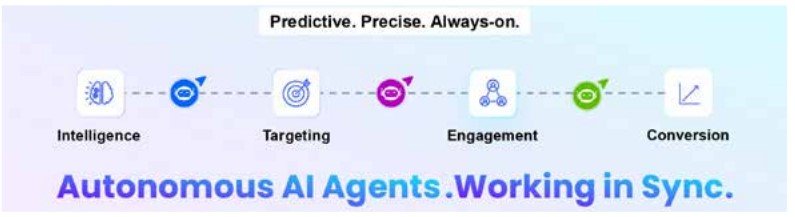
What enterprises actually need now is a model in which intelligence, engagement, qualification, and conversion are not separate stages—they work simultaneously, adapting in real time to buyer behavior.
At Denave, this evolution is something we have been building toward for some time. Over 27 years, we have navigated multiple market shifts. What makes this moment different is the pace of change and its structural nature.
Denave has transitioned as an AI-driven Sales Enablement company, with Agentic-led GTM at the core, while keeping experienced people as the primary driver of client outcomes.
Where does Sales Intelligence fit into this transformation?
Sales Intelligence is becoming the operational backbone of modern revenue execution—and most enterprises are significantly underutilizing it.
The data is already there. Most organizations have CRM activity, engagement metrics, intent signals, technographics, and market data sitting in disconnected systems. The problem is that very few can consistently answer the questions that actually matter:
• Which accounts are genuinely in a buying cycle right now?
• Which stakeholders are driving the decision—and who is influencing them behind the scenes?
• Which industries are accelerating investment in your solution category?
• Which opportunities justify immediate commercial attention versus longer-term nurture?
That gap is expensive. Not in theory—in real pipeline, real conversions, and real revenue lost to competitors who had better visibility.
This is precisely the problem that Denave’s IntelliBank is built to solve. IntelliBank functions as the intelligence core behind our Sales Intelligence practice—unifying intent data, firmographic signals, technographic intelligence, engagement patterns, and market context into a single prioritization layer. It helps enterprises surface high-propensity opportunities earlier, improve targeting accuracy, and enable revenue decisions that are based on evidence rather than instinct.
With AI advancing so rapidly, what role does human expertise continue to play?
An essential one—and I would argue, a more demanding one than before.
AI can process signals faster than any team. It can detect behavioral patterns, optimize outreach sequencing, and surface prioritization cues at a scale no human operation can match. But enterprise trust is still built in conversations, in relationships, in the moments where a senior buyer decides whether a vendor truly understands their business.
In sectors like IT services, telecom, cloud, and cybersecurity—buying decisions involve significant investments and long-term operational stakes. The data can tell you that an account is ready. The human has to convert that readiness into a relationship.
The numbers support this. Organizations that build strong human-AI collaboration models are 4X more likely to drive innovation and 1.4X more likely to achieve year-on-year profitability growth. That is not a coincidence. It reflects the compounding effect of combining machine-speed intelligence with human-quality judgment.
What measurable outcomes are enterprises actually expecting from intelligence-led Demand Generation today?
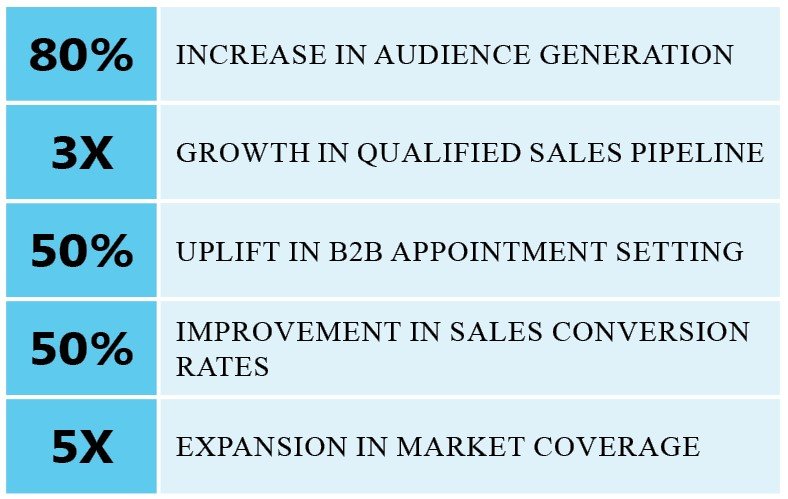 The conversation has shifted decisively. Enterprise leaders are no longer impressed by pipeline volumes or MQL counts. They want to see conversion efficiency, account penetration depth, and a direct line between GTM investment and revenue impact.
Across the programs we have delivered, Denave has helped enterprise clients achieve:
What drives these outcomes is not any single capability in isolation. It is the integration—AI-powered targeting layered with predictive prioritization, multilingual engagement, buying-group mapping, and human-led outreach—all functioning as one connected system rather than a set of disconnected campaigns.
For enterprise IT organizations specifically, that means sharper ICP alignment, faster entry into active accounts, stronger conversion confidence, and more efficient GTM execution across a wider set of markets.
What will separate market leaders over the next five years, and how is Denave positioning itself for that future?
AI adoption, by itself, will not create differentiation. Nearly every enterprise will have some form of AI embedded in its GTM by the end of the decade. What will separate the leaders is how effectively they operationalize intelligence, and how quickly they can act on it.
The long-term advantage will come from combining agentic intelligence with deep human expertise in a way that is genuinely synchronized—not just layered on top of each other. AI accelerates decisions and surfaces predictive insights at scale. But enterprise growth still depends on human judgment, market context, and the ability to navigate complex organizational dynamics with credibility.
Denave’s trajectory over 27 years has been built on exactly that balance. From our beginnings to where we stand today—operating across 5 continents, 50+ countries, and 500+ cities—we have consistently adapted alongside how enterprise buying environments evolve. Our current focus is on tightly connecting agentic-led demand generation, predictive sales intelligence, and experienced human delivery into GTM systems that help organizations convert fragmented signals into measurable revenue outcomes.
We do not see AI as a disruption to manage. We see it as the enabler of a better version of what Denave has always done: helping enterprises grow with precision, speed, and accountability.