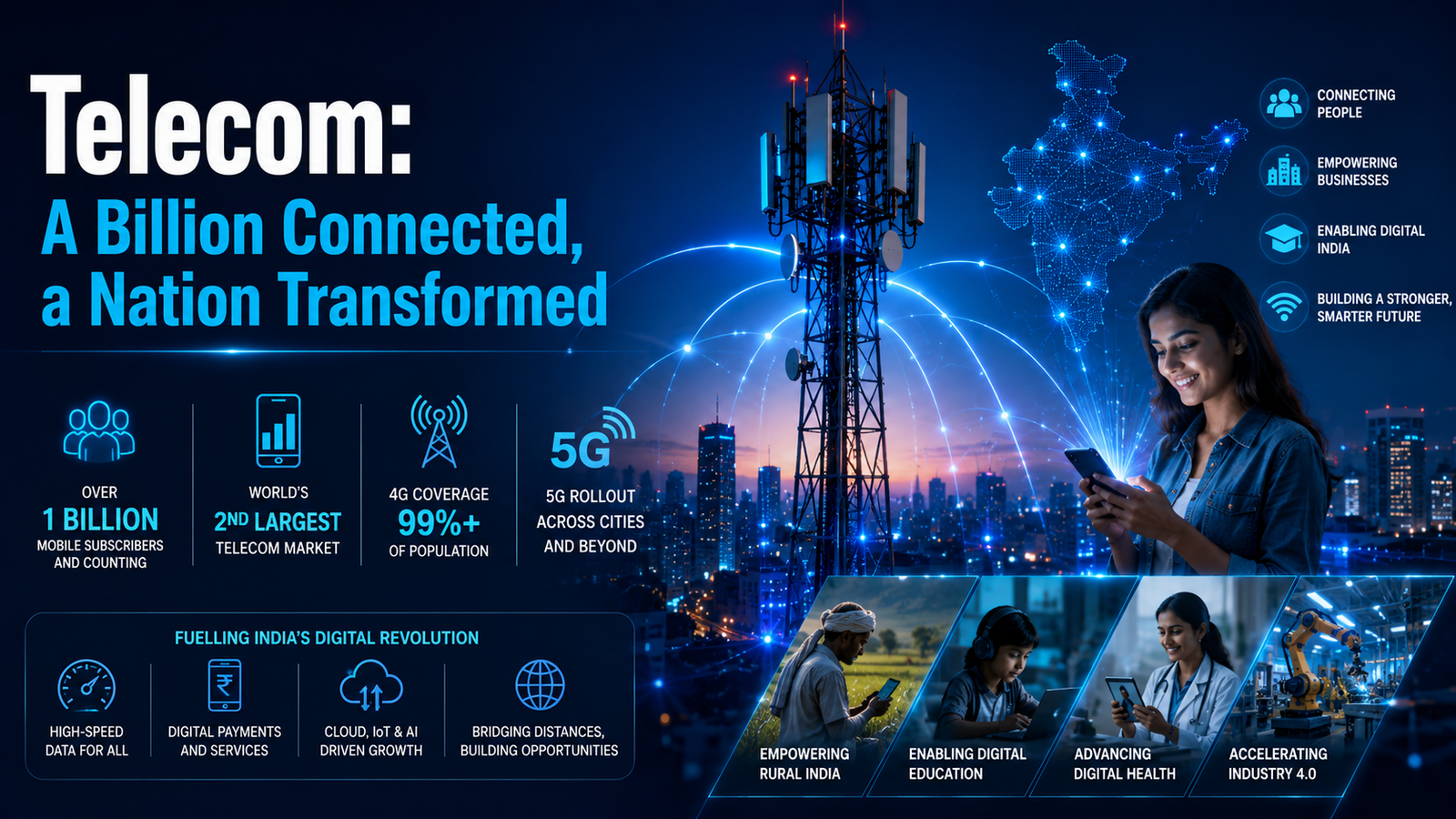
India closed fiscal 2025–26 with 1.33 billion telecom subscribers, 400 million 5G users, and a sector generating $43 billion in annual revenue — cementing its position as the world's second-largest telecom market and setting the stage for the next phase of its digital journey
India's telecom sector entered fiscal 2025–26 carrying the momentum of one of the fastest 5G rollouts in history, a tariff regime that had finally begun to push average revenues upward, and a regulatory environment more supportive of operator investment than at any point in the previous decade. By March 2026, the sector had added 9.28 million new subscribers in a single month, crossed 1.06 billion broadband users, and recorded 518,854 operational 5G base transceiver stations across the country. The numbers, drawn from TRAI's March 2026 telecom subscription data, tell the story of an industry in the midst of a structural transformation: from a commodity voice and data business to an intelligent, high-value digital infrastructure that underpins everything from AI data centres to satellite broadband to enterprise IoT.
The Market: $43 Billion and Growing
India's telecom sector generated gross revenue of $43.42 billion in FY2025, up from $39.22 billion in FY2024, according to data cited by IBEF and compiled from TRAI filings. IMARC Group values the India telecom market at $37.79 billion in 2025 on a services-revenue basis, projected to reach $72.32 billion by 2034 at a CAGR of 7.48 percent. Data and messaging services dominate the market with a 72 percent share in 2025, according to IMARC Group, driven by exponential mobile internet consumption, proliferation of streaming platforms, and widespread digital payments adoption.
Subscriber Snapshot: A Complete Picture as of March 2026
TRAI's Telecom Subscription Data for March 2026, released on April 22, 2026, provides the most authoritative and complete picture of India's telecom sector at the close of fiscal 2025–26. The headline figures tell the story of a sector that has achieved near-universal reach while simultaneously upgrading its quality of service.
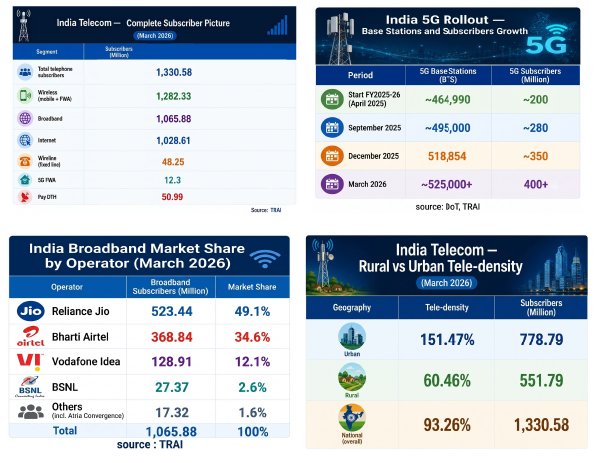
Total subscribers: 1,330.58 million, up from 1,200.80 million at the end of March 2025, per TRAI. The sector added 9.28 million new subscribers in March 2026 alone, at a monthly growth rate of 0.70 percent.
Wireless (mobile and Fixed Wireless Access): 1,282.33 million, with 9.02 million net additions in March 2026. Of these, pure mobile subscribers stood at 1,265.73 million. Private operators dominated with 92.64 percent market share; BSNL and MTNL together held 7.36 percent.
Wireline (fixed line): 48.25 million at the end of March 2026, up from 47.99 million in February 2026, adding 0.25 million subscribers. While wireline remains a small fraction of total subscribers, it is growing steadily — driven not by traditional fixed telephony but by enterprise leased lines, fibre broadband connections, and business connectivity demand.
Reliance Jio led wireline with a 31.58 percent share at 15.24 million subscribers, followed by Bharti Airtel at 23.67 percent with 11.42 million subscribers.Broadband: 1,065.88 million, crossing the billion mark for the first time and adding 6.83 million users in March 2026 alone. Broadband subscriptions have grown from 149.75 million in CY2016 to over 1.06 billion by March 2026 — a sevenfold expansion in a decade. Reliance Jio led broadband with 523.44 million subscribers, followed by Bharti Airtel at 368.84 million, Vodafone Idea at 128.91 million, and BSNL at 27.37 million.
Internet subscribers: 1,028.61 million as of December 2025, per TRAI's quarterly performance indicator report. Of these, narrowband internet subscribers stood at 21.25 million at end of December 2025, declining 4.18 percent from September 2025 as users upgraded to broadband connections.
Fixed Wireless Access (FWA): 5G FWA subscribers crossed 12.3 million by March 2026, with a near-equal urban-rural split — urban at 71.23 percent (8.77 million) and rural at 28.77 percent (3.53 million). FWA is emerging as a powerful tool for extending broadband into households and small businesses that fibre has not yet reached, and both Jio and Airtel are deploying FWA aggressively as a 5G monetisation vehicle.
Rural versus urban: Urban areas accounted for 778.79 million subscribers, while rural regions reached 551.79 million at end of March 2026. Rural wireless subscriptions grew at 0.74 percent monthly, slightly outpacing urban growth at 0.68 percent — a positive signal for digital inclusion. Urban tele-density stood at 151.47 percent, reflecting multiple connections per person in cities, while rural tele-density was 60.46 percent — indicating significant room for further rural penetration. Overall national tele-density rose to 93.26 percent by March 2026.
Pay DTH: India's pay direct-to-home television subscriber base stood at 50.99 million for the quarter ending December 2025, declining from 52.78 million in the September 2025 quarter, as streaming platform adoption continues to displace traditional satellite television among urban subscribers.
This comprehensive subscriber picture confirms that India's telecom infrastructure is now the backbone of a billion-plus connected population — with broadband penetration that surpasses most comparable economies, a rural connectivity expansion that is deepening digital inclusion, and a wireless-first architecture that defines how Indians access digital services across every sector of the economy.
The 5G Story: 400 Million Users, 518,854 Towers
India's 5G rollout, which began in October 2022, has been one of the fastest in the world. By the end of December 2025, India had 518,854 5G base transceiver stations in operation, up from approximately 464,990 at the start of the year, according to government data cited by RCR Wireless in January 2026. The country crossed 400 million 5G subscribers by January 2026, making it the world's second-largest 5G market after China, ahead of the United States. 5G services were available in 99.9 percent of Indian districts by November 2025, supported by over 5 lakh BTS installations, according to TRAI data.
The 5G subscriber projection is equally compelling. India's 5G user base is projected to grow from 400 million in early 2026 to 980 million by 2030, according to IBEF. The government has set a target of 1 billion 5G subscribers by 2031, confirmed by Union Communications Minister Jyotiraditya Scindia in February 2026. Average monthly data usage per smartphone is expected to reach 62 GB by 2030, up from approximately 24 GB currently. The 5G infrastructure market, valued at Rs 1,19,966 crore ($14 billion) in 2025, is projected to reach Rs 49,18,606 crore ($574.4 billion) by 2035 at a 45 percent CAGR, according to IBEF.
Fixed Wireless Access emerged as one of the most commercially significant 5G applications in fiscal 2025–26. Jio and Airtel both reported adding over a million home broadband connections per month through FWA, as 5G-enabled broadband began competing directly with fibre in urban and peri-urban markets. FWA is proving to be the most compelling monetisation story for 5G in India — delivering broadband to households and MSMEs that cable operators have historically struggled to reach.
BSNL advanced its indigenous technology agenda, rolling out its Swadeshi BSNL 4G network — developed entirely with Indian technology partners C-DOT, Tejas Networks, and TCS — across 93,511 sites by late 2025, with 5G planning underway on a revenue-share model with private operators. Vodafone Idea launched 5G services across 17 priority circles and 29 cities in fiscal 2025–26, deploying 10,829 broadband sites in Q2 FY26 alone to begin closing the infrastructure gap with Jio and Airtel.
The Tariff Reset: ARPU Rises, Revenue Quality Improves
The single most consequential structural development in India's telecom sector over the past two years has been the tariff reset — operators finally raising prices after a decade of a damaging race to the bottom that had driven per-user revenue to among the lowest levels anywhere in the world. Fiscal 2025–26 was the year those increases translated into measurable revenue quality improvement.
Bharti Airtel maintained industry leadership in ARPU, reporting Rs 256 per month in Q2 FY26 (July–September 2025), up from Rs 233 a year earlier — a 9.9 percent year-on-year improvement, according to the company's Q2 FY26 results. Reliance Jio's ARPU rose to Rs 211.4 in Q2 FY26, up 1.2 percent sequentially, while Vodafone Idea reported Rs 167 amid improving data consumption and premium-plan adoption, according to industry review by Centrum.
Despite Airtel's ARPU leadership, Jio retained its dominance in subscriber scale and net profit. Jio added 8.3 million subscribers in Q2 FY26, taking its base to 506.4 million, while reporting a net profit of Rs 7,379 crore versus Airtel's Rs 6,792 crore for the same quarter. The competitive dynamic between the two operators — Airtel leading on revenue quality and margins, Jio leading on scale and profit — defined the market narrative through the fiscal year.
For Q3 FY26 (October–December 2025), Bharti Airtel reported India revenue of Rs 39,226 crore, growing 13.2 percent year-on-year, while Reliance Jio reported revenue of Rs 37,262 crore, growing 12.7 percent YoY, according to company results published in February 2026. Overall, industry revenue is projected to reach Rs 3.5–3.7 lakh crore for FY2026, according to analyst estimates.
Key Players: A Market Defined by Duopoly
India's telecom market has consolidated into a clear duopoly, with Reliance Jio and Bharti Airtel commanding the overwhelming share of revenue, subscribers, and investment, while Vodafone Idea and BSNL occupy significantly smaller positions.
Reliance Jio maintained its position as India's largest telecom operator by subscribers, with 496.33 million wireless subscribers at the end of March 2026, representing approximately 39.2 percent market share, according to TRAI data. Jio's 5G subscriber base reached approximately 268 million by March 2026, making it the largest 5G operator in the country. Jio's gross revenue for Q2 FY26 was Rs 42,652 crore, up 14.9 percent YoY. Beyond its telecom business, Jio's broader digital ecosystem — JioFibre, JioCinema, JioMart, and enterprise cloud services — continued to expand, reinforcing its position as India's largest integrated digital platform. A landmark development anticipated for fiscal 2025–26 is Jio's planned IPO in the first half of 2026, which analysts project could value Jio Platforms at $120–170 billion, potentially making it one of India's largest public companies. Jio also announced a partnership with Google to offer subscribers complimentary access to Gemini AI Pro for 18 months — a move that positions Jio at the intersection of telecom and AI services delivery. In December 2025, Jio signed an MoU with the National Highways Authority of India to deploy a telecom-based highway safety alert system across national highways, leveraging its 4G/5G network for intelligent transport infrastructure.
Bharti Airtel added 5.09 million subscribers in March 2026, reaching 477.74 million — second in market share but first in revenue quality, ARPU, and margin performance. Airtel's consolidated Q3 FY26 revenue stood at Rs 53,982 crore, up 19.6 percent YoY, supported by strong India wireless, home broadband, and Africa operations. The company's smartphone customer base reached 78 percent of its total subscriber base, reflecting its successful premium-tier strategy. Airtel Business, its enterprise division offering data centres, cloud, IoT, and cybersecurity services, returned to sequential growth after three quarters of decline, signalling enterprise connectivity recovery. Airtel's brand value reached $8.1 billion, ranking 17th globally. On the AI front, Airtel tied up with Perplexity AI to offer subscribers access to AI-powered search and information services — competing directly with Jio's Google Gemini partnership in the AI-on-telecom battleground.
Vodafone Idea continued to navigate a challenging position in fiscal 2025–26 — high debt, subscriber losses, and the need to accelerate capital expenditure simultaneously. Vi reported a net subscriber decline in Q2 FY26 but expanded 5G services to 29 cities, deployed over 527,000 broadband sites, and launched 5G in Dehradun and other cities as part of its 17-priority-circle rollout. The government, which holds equity in Vi through AGR dues conversions, provided regulatory relief on AGR payment deferrals, easing immediate liquidity concerns. Vi's survival and competitive recovery is seen as important for maintaining market competition and preventing a further slide into a single-operator duopoly that could harm consumers.
BSNL advanced its Make in India telecom agenda with the full rollout of its indigenous 4G network across 93,511 sites, connecting over 22 million subscribers as of September 2025. BSNL's 4G network integrates a C-DOT-developed core, Tejas Networks radio access solutions, and TCS integration — the most significant deployment of Indian-origin telecom technology at scale. 5G planning is underway through a revenue-share model. The government has instructed states and central ministries to prioritise BSNL and MTNL for telecom procurement, providing institutional demand support for the state-owned operator.
Tata Communications, operating at the enterprise and wholesale connectivity layer, posted 6.5 percent year-on-year revenue growth in Q2 FY26, driven by rising demand for digital services and a stable global connectivity business. Tata Communications serves as a critical link between India's domestic telecom ecosystem and international networks, handling a significant share of India's enterprise data and cloud connectivity traffic.
Satellite Communications: The New Frontier
Fiscal 2025–26 was the year India's satellite communications market moved from regulatory debate to operational reality. The government issued three SATCOM licences and formalised licensing and regulatory frameworks for satellite broadband services. Elon Musk's Starlink, Amazon's Project Kuiper, and Eutelsat OneWeb all received regulatory approvals or advanced their licensing processes, creating the prospect of commercial satellite broadband in India within fiscal 2026–27. Union Minister Scindia cited a $25 billion opportunity in telecom component manufacturing related to satellite communications.
Jio Platforms — which holds a stake in SES's satellite operations — and Airtel's OneWeb partnership position both major operators to participate in the satellite broadband market, blurring the line between terrestrial and non-terrestrial network services. The satcom market is expected to double over the next few years, according to IBEF. BharatNet Phase III, targeting broadband connectivity to 6.4 lakh villages using a combination of fibre, wireless, and satellite technologies, represents the government's most ambitious rural connectivity programme and a direct driver of satcom demand.
6G and India's Telecom Export Ambition
India is thinking beyond 5G. The Bharat 6G Mission, anchored by the Department of Telecommunications, is developing India's indigenous 6G technology stack — building on the learnings from BSNL's homegrown 4G deployment and Jio's proprietary 5G platform. The Bharat 6G Alliance has formalised a partnership with the European Telecommunications Standards Institute for co-development of 6G standards, positioning India as a co-architect rather than a technology adopter in the next generation of wireless.
Jio Platforms has made it clear it intends to export its indigenously developed 5G stack to global markets, particularly countries in the early stages of 5G deployment. The National Frequency Allocation Plan 2025 (NFAP-2025), released by DoT effective December 30, 2025, aligned India's spectrum usage with global standards to support emerging technologies including 6G, IoT, and satellite communications. India aims to become a hub for telecom exports and innovation — a vision articulated by Minister Scindia at the inauguration of Bharat Telecom 2025.
The Road Ahead: AI Networks, Satcom, and ARPU Growth
India's telecom sector enters fiscal 2026–27 with strong structural tailwinds and clear strategic priorities. ARPU must continue its upward trajectory — at current levels, even Airtel's Rs 256 per month remains well below what is required to fully fund 5G capacity expansion and generate adequate returns on spectrum investment. Jio's IPO, if completed in 2026, will provide both capital and a market valuation benchmark that could accelerate further investment in the sector.
AI is beginning to reshape telecom operations and services delivery. Operators are deploying AI for network optimisation, predictive maintenance, fraud detection, and customer service automation. Enterprise connectivity — connecting AI data centres, supporting IoT infrastructure, enabling edge computing — is the fastest-growing revenue segment for both Jio and Airtel's enterprise divisions. The convergence of telecom, AI, and cloud is creating integrated digital platform businesses that look increasingly different from the voice-and-data operators of a decade ago.
India's 5G subscriber base is projected to reach 980 million by 2030 and 1 billion by 2031. The telecom market is projected to reach $72.32 billion by 2034. The country's telecom infrastructure — its towers, fibre, spectrum, and now satellite assets — is the backbone of every other technology story told in this Brand Book. Without it, none of the other chapters are possible.