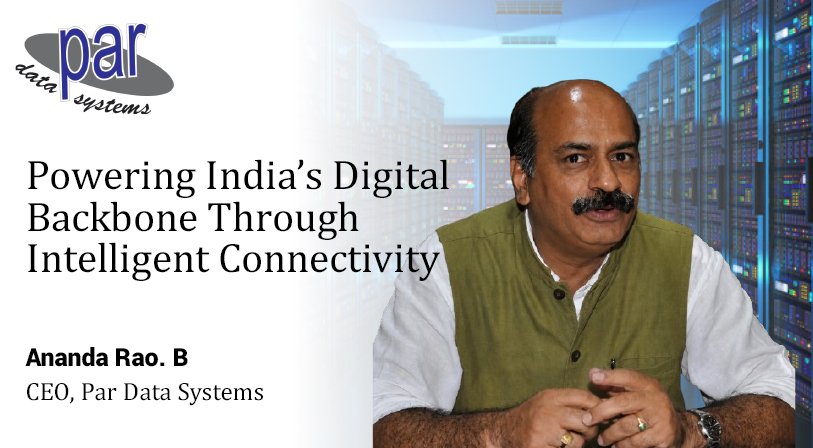
Ananda Rao. B
CEO, Par Data Systems
What is the current size of the structured cabling market in India, and what is its future growth potential?
The structured cabling market in India is valued at approximately USD 841.76 million and is projected to reach USD 1,764.72 million by 2034, growing at a CAGR of 8.57%. Growth is being driven by the government’s digital transformation push, widespread 5G rollouts, and rapid corporate cloud adoption.
The future growth potential is anchored by the transition from traditional copper infrastructure to high-density fibre-optic solutions that can handle rising data traffic. Regional demand is concentrated in South India due to its strong technology hub presence and smart city initiatives. While Category 6 copper solutions continue to support standard commercial LANs, demand for high-bandwidth, future-ready networks will drive advanced cabling deployments.
Which key industry verticals drive the highest demand for networking as a critical component of IT infrastructure?
The highest demand comes from heavily data-reliant sectors. Key industry verticals for structured cabling include IT, ITES, Manufacturing, Education, Healthcare, Hospitality, Government, Defence, Space & R&D, Retail (medium and large format), Real Estate, Airports, and the rapidly growing Data Centre segment.
How does the market penetration of enterprise networking compare to that of data centre solutions in India?
Enterprise networking enjoys a wider and more mature footprint across corporate offices, campus LANs, retail chains, and bank branches in tier-1 and tier-2 cities, focusing on connectivity and workforce mobility.
Data centre solutions represent a more concentrated, high-value market. Driven by over 200 pipeline projects and significant planned investments, the data centre hardware market is expanding at a CAGR of over 10%. While enterprise networks serve distributed environments, data centre deployments are clustered around hubs such as Maharashtra, Delhi-NCR, and Chennai. The shift of workloads to public and hybrid cloud environments is accelerating this trend.
Could you highlight the current and future opportunities for the Structured Cabling Systems (SCS) business within India’s booming data centre market?
India’s data centre ecosystem presents significant opportunities for the SCS business. Hyperscale data centres supporting AI training and inference workloads require ultra-low-loss single-mode and multi-mode fibre, MPO/MTP connectivity, high-density patch panels, and modular distribution frames.
The growth of edge data centres in tier-2 and tier-3 cities, driven by 5G and IoT adoption, is increasing demand for pre-terminated, plug-and-play SCS solutions. In addition, Automated Infrastructure Management (AIM) software enables real-time monitoring and documentation of physical layer connectivity, creating opportunities for specialized SCS integrators.
From the Distributor’s perspective how do you assess CommScope’s market presence and competitive strength against rival brands in India?
CommScope’s Systimax and NetConnect portfolios are widely recognized for predictable performance and comprehensive 25-year structural warranties. Its strengths include high-density fibre arrays, Cat 6, Cat 6A, Cat 7 and Cat 8 copper systems, and AIM capabilities that support long-term infrastructure management and customer partnerships.