India became the first major economy to establish an enforceable legal framework for deepfakes in February 2026, as AI-generated fraud, political manipulation, and non-consensual content made synthetic media one of the most urgent technology policy challenges of the decade
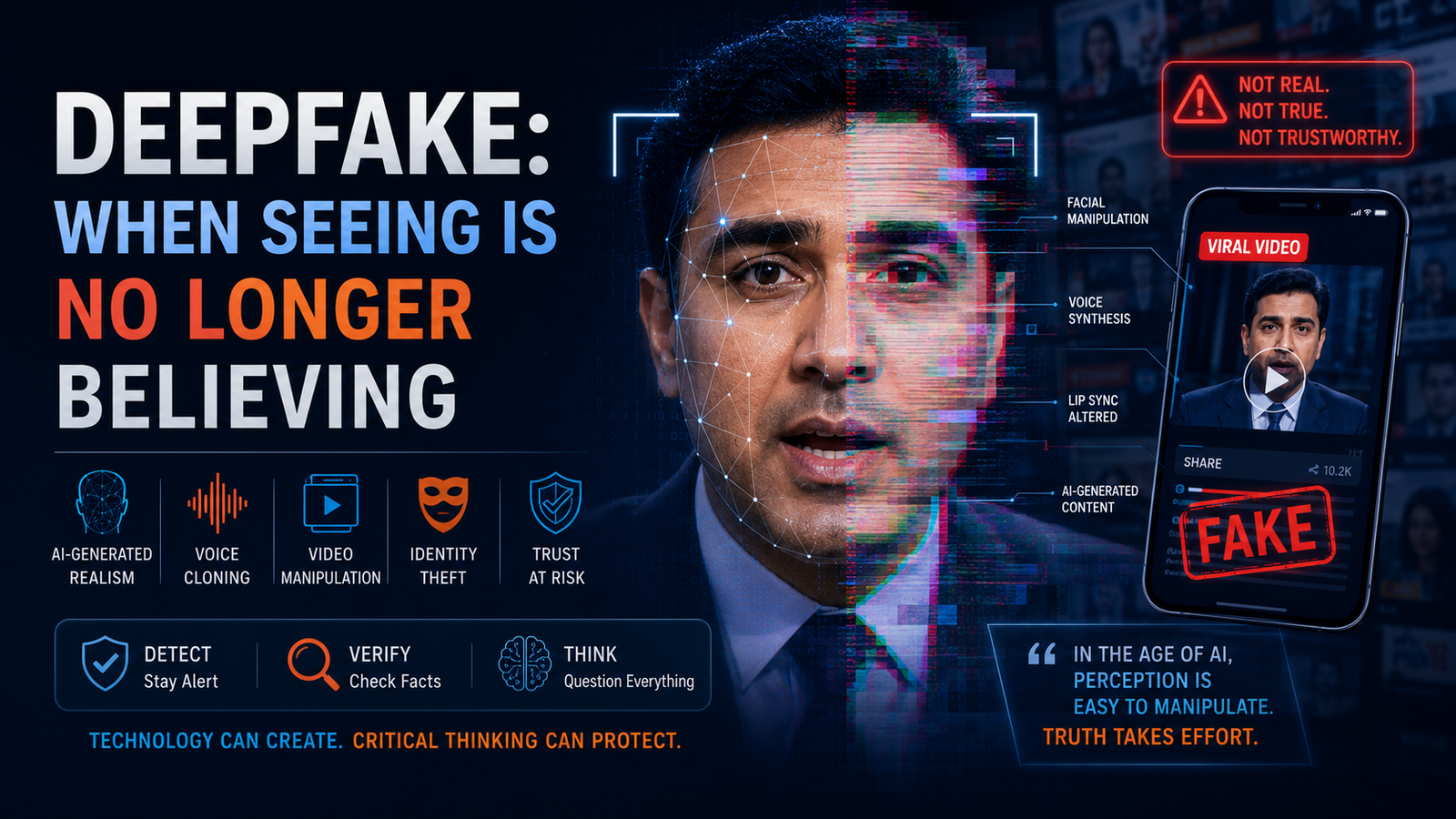
The video arrived on WhatsApp. A 79-year-old woman in Bengaluru watched a familiar face — N.R. Narayana Murthy, founder of Infosys, one of India's most trusted business figures — speak convincingly about a trading platform that would change her financial future. She invested. The platform was fake. The video was a deepfake. She lost Rs 35 lakh. The gang behind the fraud had also used deepfakes of Mukesh Ambani to con two more victims out of Rs 95 lakh. The cases are not isolated. They are representative of a pattern that has spread from WhatsApp forwards to financial platforms, election campaigns, corporate boardrooms, and newsrooms — and in fiscal 2025–26, they became urgent enough to force India's government into the most consequential regulatory intervention in the country's internet governance history.
The Global Market: Two Sides of the Same Technology
The deepfake technology market encompasses two distinct and growing segments that are frequently conflated but must be understood separately: deepfake generation tools, which create synthetic media, and deepfake detection and authentication platforms, which identify and flag it. Both are growing rapidly, driven by the same underlying force: the rapid advancement and democratisation of generative AI.
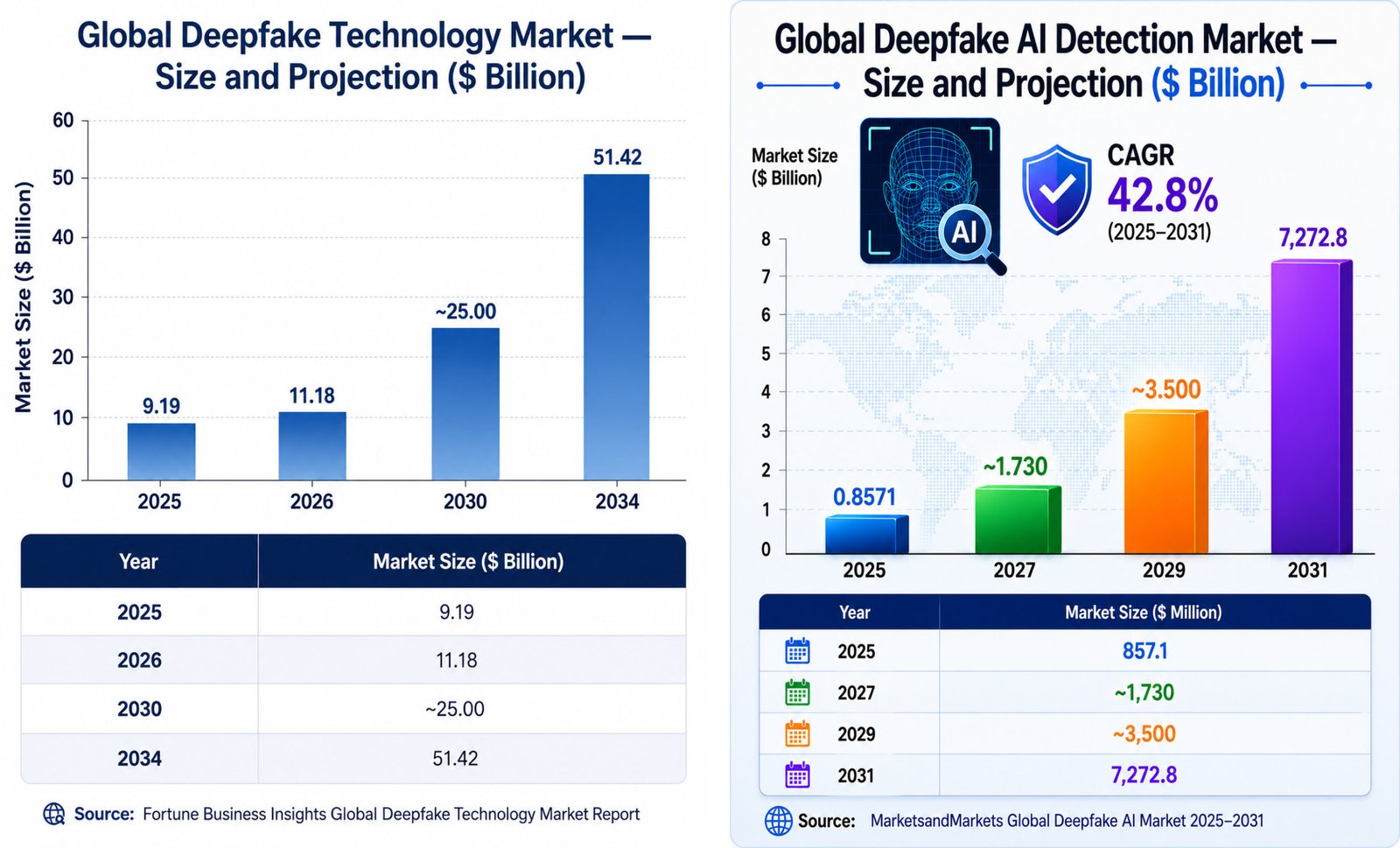
The global deepfake technology market — covering both generation and detection — was valued at $9.19 billion in 2025 and is projected to grow to $11.18 billion in 2026, reaching $51.42 billion by 2034 at a CAGR of 21 percent, according to Fortune Business Insights. Asia Pacific dominated the global market with a 37.60 percent share in 2025, valued at $3.45 billion, and is projected to reach $4.3 billion in 2026 — reflecting both the high volume of deepfake incidents in the region and the rapid deployment of detection infrastructure.
For the detection segment specifically, MarketsandMarkets estimates the global deepfake AI market at $857.1 million in 2025, projected to grow to $7,272.8 million by 2031 at a CAGR of 42.8 percent. The detection and authentication software sub-segment holds the largest share within this market. India's deepfake technology market is projected to reach $0.71 billion by 2026, according to Fortune Business Insights — a relatively modest absolute figure that understates the severity of the problem, given that India's deepfake fraud losses vastly exceed the size of the detection market deployed against it.
India's Deepfake Crisis: The Scale of the Problem
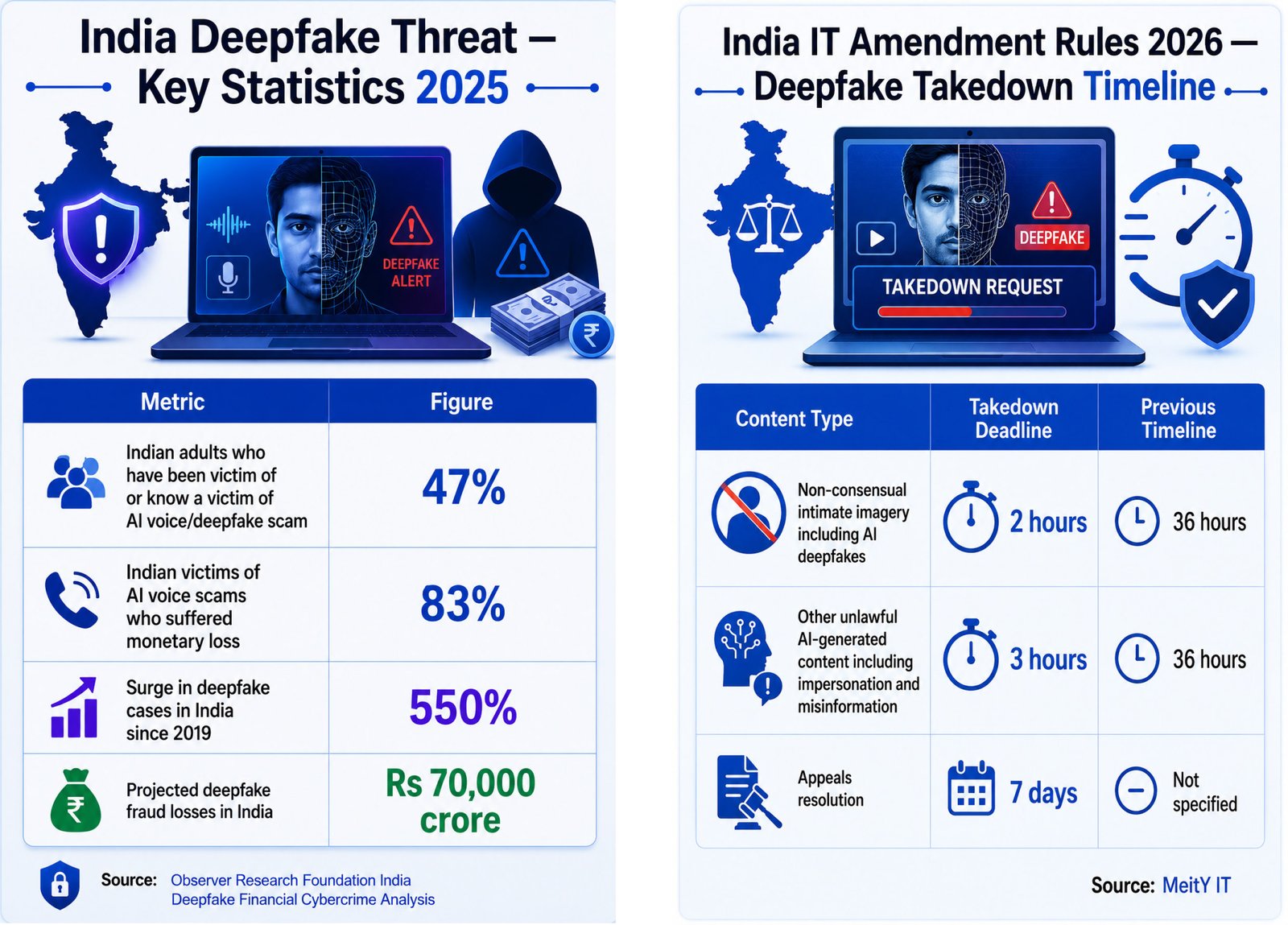
India is disproportionately exposed to deepfake-enabled harm. A 2025 analysis cited by the Observer Research Foundation reported that 47 percent of Indian adults have either been victims of, or know someone who has been a victim of, an AI voice-cloning or deepfake scam — nearly double the global average of 25 percent. Of Indian victims of AI voice scams, 83 percent suffered monetary loss, with almost half losing over Rs 50,000. Deepfake cases in India have surged 550 percent since 2019, with projected losses reaching Rs 70,000 crore in 2024 alone, according to a 2024 report by Pi-Labs.
Three structural factors make India unusually vulnerable. First, sheer digital scale: active internet users reached 886 million in 2025, an 8 percent year-on-year increase, according to the IAMAI-Kantar Internet in India Report 2025, with 85 percent of households expected to own a smartphone. Average monthly data use per subscriber now exceeds 24GB, most of it video. Second, digital consumption has outrun digital literacy — for many users, what appears on a screen still carries the aura of truth. Third, the affordability and accessibility of deepfake creation tools has collapsed: a 2025 industry analysis found that 91 percent of deepfakes can be created for under $50 in approximately 3.2 hours, with only 3 seconds of audio needed to create an 85 percent accurate voice clone.
Fiscal 2025–26 produced a string of high-profile incidents that collectively defined the urgency of India's response. In June 2025, the Bengaluru fraud using deepfaked videos of Narayana Murthy and Mukesh Ambani defrauded victims of over Rs 1.3 crore across multiple cases. The National Stock Exchange issued warnings after deepfake videos of NSE officials were used to mislead retail investors into fraudulent schemes. In May 2025, the Delhi High Court granted John Doe interim relief to entrepreneur Ankur Warikoo after AI-generated videos falsely portrayed him endorsing WhatsApp groups and fraudulent stock-tip schemes — one of the earliest Indian judicial responses to deepfake-enabled financial fraud causing tangible monetary harm. In January 2025, media personality Rajat Sharma, Chairman and Editor-in-Chief of India TV, approached the Delhi High Court after manipulated videos using his likeness and voice were used to perpetrate financial scams. In Navsari, a man sharing a deepfake of the Prime Minister was arrested within 24 hours, with police invoking BNS public-order offences and IT Act provisions. The Bombay High Court upheld the personality rights of actor Kartik Aaryan in a ruling that specifically addressed AI and deepfake threats as an emerging legal challenge.
The financial sector remains the most targeted. Deepfake fraud constitutes approximately 40 percent of all AI-related cybercrimes globally, and in India the BFSI sector is the primary vector — through fake executive impersonation for fund transfers, fabricated regulatory communications, and synthetic identity fraud in digital KYC processes. Businesses face an average loss of $440,000–$500,000 per deepfake fraud incident, according to industry data.
The Regulatory Landmark: India's IT Amendment Rules 2026
The most consequential development in India's deepfake story in fiscal 2025–26 was not a fraud case or a court ruling. It was a gazette notification. On February 10, 2026, the Ministry of Electronics and Information Technology notified the Information Technology (Intermediary Guidelines and Digital Media Ethics Code) Amendment Rules, 2026, with effect from February 20, 2026 — ten days from notification to enforcement. India became the first major economy in the world to establish an enforceable legal framework specifically targeting deepfakes and synthetic media, moving beyond voluntary guidelines and industry codes into binding obligations with criminal penalties attached.
The Rules define "synthetically generated information" broadly, covering any computer-generated or algorithmically altered audio, visual, or audiovisual content that appears authentic — encompassing deepfakes, AI-generated voice clones, fabricated images, and text impersonating official sources. The core obligations are demanding. Platforms must embed permanent visible watermarks or metadata identifiers on all synthetic content, covering at least 10 percent of the display area for images and videos, and during the first 10 percent of playback for audio. These markers cannot be stripped or removed by users. Significant Social Media Intermediaries, defined as platforms with over 5 million registered users, must collect user declarations on AI-generated content, deploy automated detection tools with at least 50 percent accuracy verification, and label confirmed synthetic content prominently.
The takedown timelines are among the most aggressive in the world. Non-consensual intimate imagery, including AI-generated deepfake imagery, must be removed within 2 hours of a government or judicial order. Other unlawful AI-generated content, including impersonation and misinformation, must be removed within 3 hours — compared to the previous 36-hour window and significantly stricter than the EU AI Act's approach. Appeals must be resolved within 7 days. Failure to comply exposes platforms to loss of safe harbour protection, direct liability for hosted content, and criminal penalties under the Bharatiya Nyaya Sanhita, 2023.
The Rules require platforms to inform users at least once every three months about compliance obligations and the consequences of misusing AI generation tools. Platforms offering AI creation tools must warn users that misuse may attract criminal penalties. The government's detection infrastructure is also advancing: C-DAC leads government-backed research on automated deepfake identification, with a prototype tool reportedly achieving 89 percent accuracy across global benchmarks, according to MeitY, though independent validation remains ongoing.
In April 2026, MeitY proposed a further tightening of disclosure norms for AI-generated content, signalling that the February 2026 framework is the beginning of a regulatory journey rather than its conclusion.
Key Players: Detection, Compliance, and the Emerging Ecosystem
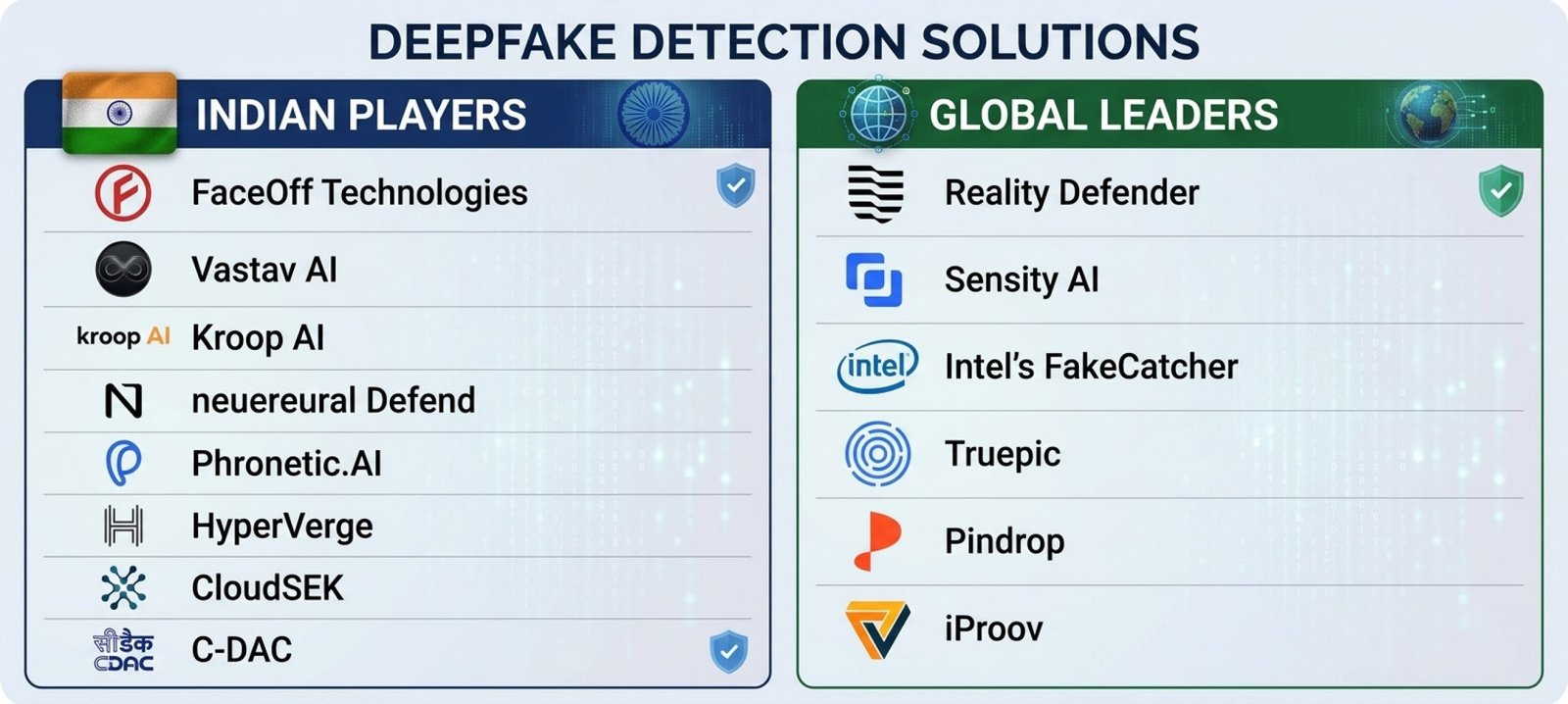
The deepfake detection landscape in India in fiscal 2025–26 operated across two clear tiers: global technology platforms deploying enterprise-grade detection infrastructure, and a growing set of Indian-origin companies building detection, authentication, and compliance tools specifically designed for India's regulatory environment and threat patterns.
Global Leaders
Reality Defender (US) was named by Gartner in December 2025 as "the company to beat in deepfake detection," citing its ensemble-of-models approach, multimodal platform covering video, audio, images, and text, and strong positioning in high-stakes enterprise verticals including finance, government, and media. It was also inducted into JPMorgan Chase's Hall of Innovation 2025 and named a World Economic Forum Technology Pioneer 2025, making it the most credentialled pure-play deepfake detection company globally within our fiscal year.
Sensity AI (Netherlands) operates a comprehensive detection platform with a reported accuracy rate of 95–98 percent, offering real-time monitoring across over 9,000 sources, multimodal detection covering face swaps, manipulated audio, deepfake videos, and AI-generated images, and an SDK with Face Manipulation Detection API for KYC and identity verification workflows. It is widely deployed by financial institutions and government agencies globally.
Intel's FakeCatcher takes a unique physiological approach, detecting deepfakes by analysing blood flow signals in video pixels — biological cues that synthetic media cannot reliably replicate. This makes it particularly effective for high-stakes identity verification scenarios where generation artefacts are minimal or have been deliberately obscured.
Truepic (US) differentiates itself by focusing on content authenticity at the point of capture rather than post-facto detection, embedding cryptographic trust signals into digital content at creation. Its provenance-first approach prevents misinformation before it circulates, and is widely used in journalism, elections, and corporate communications where source integrity is non-negotiable.
Pindrop (US) specialises in voice-based deepfake detection, combining liveness checks with call-context evaluation to identify synthetic speech and cloned-voice patterns in real time, designed specifically for call centre and financial services fraud prevention environments.
iProov (UK) is a liveness detection specialist widely deployed in KYC workflows across banking and government, detecting injected deepfake video streams and presentation attacks in identity verification pipelines.
Indian Players
FaceOff Technologies is an Indian deepfake detection company and its Multimodal Fusion Platform, powered by its proprietary Adaptive Cognito Engine (ACE), integrates multiple AI systems for detection and mitigation of synthetic media. FaceOff applies multi-layered AI analysis to classify video content as authentic, manipulated, or synthetically generated, assigning each piece a DeepFake Confidence Score that allows analysts to prioritise review rather than rely on binary determinations. The platform goes beyond individual detection — it can uncover patterns and networks behind deepfake creation and dissemination, and produces forensically sound reports suitable for content moderation, investigations, and legal proceedings. On the audio side, FaceOff's Voice Tone Analysis detects missing micro-emotions, stress markers, and unnatural prosody, while ACE evaluates conversational flow, cadence shifts, and response latency to flag anomalies in real-time voice interactions. Dr. Sahu has been a vocal advocate for AI-driven trust infrastructure in India's regulatory discourse, commenting publicly on the IT Amendment Rules 2026 and the broader need for a domestic deepfake governance ecosystem.
Vastav AI by Zero Defend Security is described as India's first deepfake detection system built by an Indian company, using machine learning, forensic analysis, and metadata inspection across videos, images, and audio, with a claimed accuracy of 99 percent. The platform targets media organisations, enterprises, and law enforcement.
Kroop AI (Gandhinagar) is one of the only India-headquartered companies listed in MarketsandMarkets' global deepfake AI market report. Founded in 2021, Kroop AI offers a multimodal deep learning-based platform identifying synthetic manipulations in videos, images, and audio, serving enterprise clients across media, finance, and identity verification segments. The company also provides an AI-powered text-to-video platform, reflecting the dual-use nature of synthetic media technology.
Neural Defend partnered with Zee News in fiscal 2025–26 to launch India's first deepfake verification system for news media, enabling viewers to upload suspicious videos, audio clips, or images for real-time AI authentication. Neural Defend raised over $600,000 in pre-seed funding led by Gurugram-based Inflection Point Ventures, with participation from MIT SBXI and Techstars San Francisco. The company's agentic AI detection models cover video, audio, and real-time streams, and it is running pilot projects with global enterprises and fintech companies.
Phronetic.AI (Infibeam Avenues) has partnered with IISc Bengaluru's Vision and AI Lab to develop real-time deepfake detection systems specifically for video calls, with a patent filed for its detection algorithm. The system actively monitors ongoing video calls and alerts participants in real time if the other party is identified as a deepfake — a capability with direct application in enterprise video KYC, board communications, and high-value financial authorisations.
HyperVerge offers a deepfake detection solution integrated within its broader KYC platform, certified by NIST and iBeta for facial recognition, and widely deployed across India's BFSI sector for digital onboarding and RBI-approved Video-based Customer Identification Process (V-CIP) workflows. Given the volume of digital KYC processed daily in India's banking system, HyperVerge's detection layer represents the most operationally deployed anti-deepfake infrastructure in India's financial services sector.
CloudSEK, the Bengaluru-based cybersecurity firm that became the first Indian-origin cybersecurity company to receive investment from a US state fund, is rated among the leading deepfake detection platforms in 2026, offering real-time monitoring and threat intelligence capabilities alongside its broader digital risk protection platform.
C-DAC, the government-backed Centre for Development of Advanced Computing, leads public sector deepfake detection research, with a prototype tool reportedly achieving 89 percent accuracy across global benchmarks according to MeitY. C-DAC's work directly feeds into the enforcement infrastructure required under the IT Amendment Rules 2026, and the organisation is expected to play a central role in the National Deepfake Detection Lab proposed under MeitY and CERT-In.
The Legitimate Applications: Beyond the Threat Narrative
It is important for a Brand Book audience to understand that deepfake technology is not solely a threat vector. Legitimate enterprise applications are significant and growing. In media and entertainment, synthetic media tools are used for content localisation, de-ageing actors, recreating historical figures for documentary production, and generating training data for AI models. In education, AI avatars deliver personalised multilingual instruction at scale — a particularly powerful application for India's linguistically diverse population. In healthcare, synthetic medical imaging is used to augment training datasets without compromising patient privacy. In retail, virtual try-on applications and personalised advertising use synthetic media generation to reduce production costs and improve customer experience.
D-ID's September 2025 acquisition of AI video pioneer simpleshow — merging interactive AI visual agents with enterprise video creation capabilities — represents the commercial direction of legitimate synthetic media deployment: interactive digital avatars for corporate training, onboarding, sales, and customer communication. India's enterprise market for legitimate synthetic media is estimated to be part of a $9.19 billion global market, with BFSI projected to be the fastest-growing vertical at a 48.4 percent CAGR through 2033, according to Grand View Research — driven by synthetic data generation for fraud detection model training and AI-enhanced customer service.
The Road Ahead: Detection as Infrastructure
India's deepfake governance framework, anchored by the IT Amendment Rules 2026, positions the country as a global regulatory benchmark for synthetic content governance. Analysts at Rotavision noted that India's approach is already being studied by over 30 countries as a potential template for synthetic media regulation. The three-hour takedown window, mandatory watermarking, and criminal penalties represent the strict end of the global regulatory spectrum.
For India's technology industry, the implication is clear: deepfake detection is no longer optional infrastructure. It is regulatory infrastructure. Every platform, every financial services firm, every content creator operating at scale in India must now invest in synthetic content detection, provenance management, and compliance workflows. The market for these capabilities is projected to grow from $857 million globally in 2025 to $7.27 billion by 2031, at a CAGR of 42.8 percent according to MarketsandMarkets — with India driving a disproportionate share of Asia Pacific's growth.
The technology challenge remains formidable. Current detection tools achieve 90–95 percent accuracy on known generation methods but struggle with novel techniques as the arms race between generation and detection continues. Only 0.1 percent of people correctly identify all deepfake content in controlled tests. And 47 percent of Indian adults have already been touched by this technology's darker applications. The regulations are in place. The infrastructure is being built. The question is whether detection capability can keep pace with generation velocity — and whether digital literacy can ultimately close the gap that technology alone cannot.