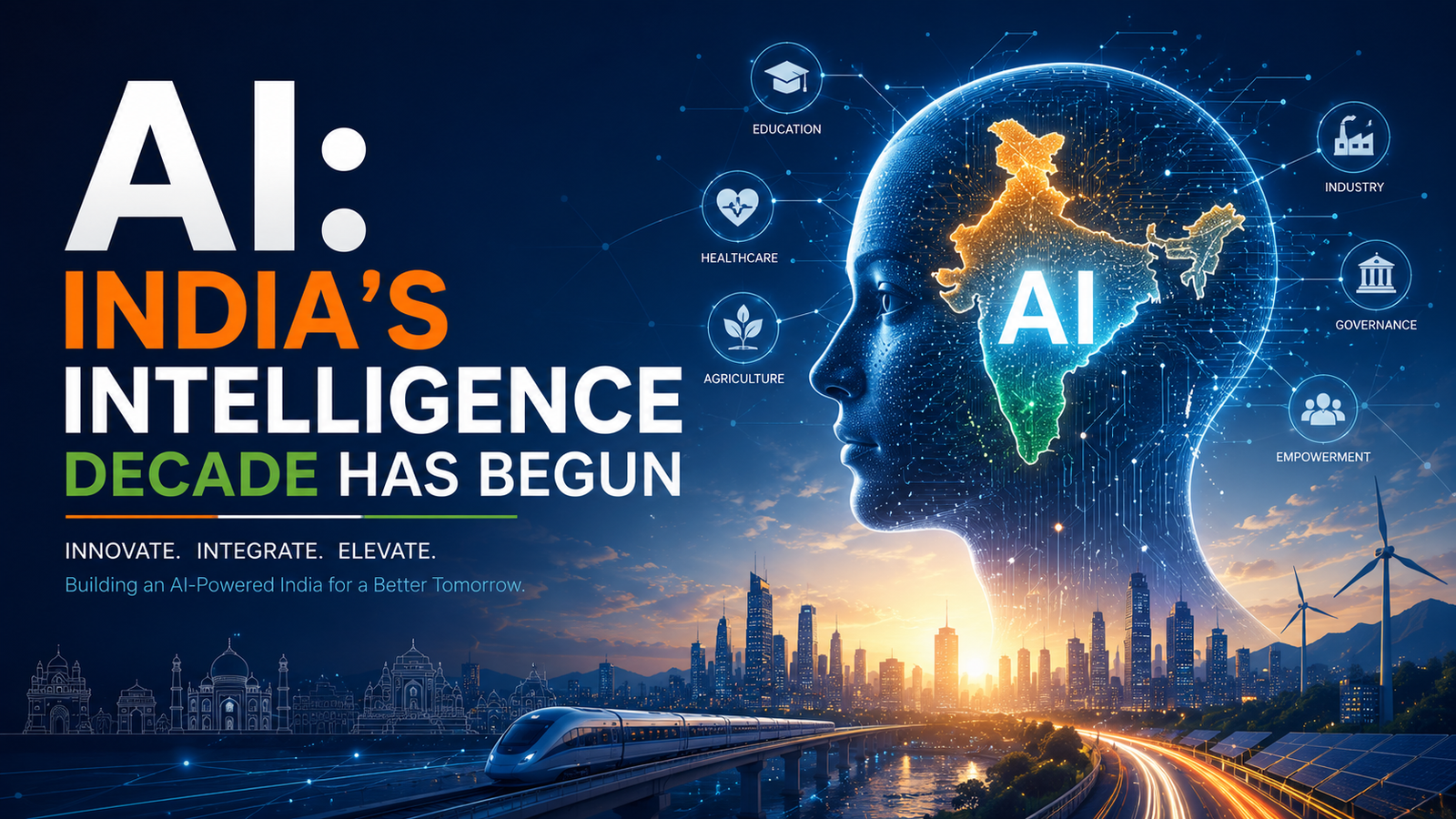
From sovereign models to agentic deployments, India is no longer just an AI consumer — it is building the architecture of its own intelligent future
When Prime Minister Narendra Modi took the stage at the India AI Impact Summit in New Delhi in February 2026, flanked by the CEOs of OpenAI, Microsoft, Google, and NVIDIA, the symbolism was hard to miss. India — long celebrated as the world's back office for technology services — was signalling something more ambitious: that it intended to be a principal architect of the intelligence age, not merely a participant in it. The billions announced that week, the sovereign models unveiled, the GPU farms humming at subsidised rates in data centres across the country — all of it pointed to the same conclusion. India's AI decade had not just begun. In fiscal 2025–26, it found its footing.
The scale of the shift is visible in the numbers. India's artificial intelligence market reached $ 13.05 billion in 2025, up from $ 9.51 billion in 2024, and is on track to hit $ 130.63 billion by 2032, expanding at a CAGR of 39 percent, according to Fortune Business Insights. The generative AI segment tells an equally steep story — Statista estimates India's generative AI market at $ 1.11 billion in 2025, growing at 41.43 percent annually to reach $ 6.28 billion by 2030. Globally, Gartner reported worldwide generative AI spending at $ 644 billion in 2025, up 76.4 percent from 2024 — and India's share of that investment is accelerating faster than almost any other market.
But the character of India's AI growth has changed in ways that raw market figures do not fully capture. The country is no longer simply adopting tools built elsewhere. It is building infrastructure, training sovereign models, funding homegrown startups, and embedding AI across the full fabric of public and private enterprise. Stanford University's 2025 Global AI Vibrancy Tool ranked India third globally in AI competitiveness, behind only the United States. With 16 percent of the world's AI talent and the second-largest volume of public generative AI projects on GitHub, India now commands serious attention in the global AI hierarchy.
The Government as Architect: IndiaAI Mission at Full Stride
No single initiative has done more to define India's AI trajectory than the IndiaAI Mission, approved by the Union Cabinet in March 2024 with a total outlay of Rs 10,371.92 crore. Implemented by IndiaAI, an independent business division under the Ministry of Electronics and Information Technology (MeitY), the mission is structured around seven pillars: affordable compute access, AI application development, the AIKosh national dataset platform, indigenous foundation model development, future skills, startup financing, and responsible AI governance.
In fiscal 2025–26, the mission moved decisively from planning to execution. More than 38,000 GPUs were onboarded and made available at a subsidised rate of just Rs 65 per hour — a figure designed to flatten the cost barrier that has historically kept smaller players, startups, and academic institutions out of frontier AI development. Over 30 India-specific AI applications were approved across sectors including healthcare, agriculture, and cybersecurity. The AIKosh platform, which consolidates datasets from government and non-government sources, expanded to over 5,500 datasets and 251 AI models across 20 sectors, recording more than 385,000 visits and 11,000 registered users as of December 2025.
The government established three AI Centres of Excellence — in healthcare, agriculture, and sustainable cities in New Delhi — and the Union Budget 2025–26 announced a fourth CoE focused on education, with a Rs 500 crore outlay. Five National Centres of Excellence for Skilling are planned under the broader "Make for India, Make for the World" vision. A dedicated IndiaAI Safety Institute is being constituted, with expressions of interest published in May 2025 for partner institutions.
In November 2025, the government released its AI Governance Guidelines — a structured, four-part operational framework anchored on what it calls "Seven Sutras" of responsible AI: fairness, accountability, transparency, safety, inclusivity, privacy, and explainability. The framework adopts a light-touch, risk-based approach, emphasising voluntary codes of conduct, human-in-the-loop requirements for high-stakes applications, and mandatory digital watermarking for AI-generated content. The guidelines integrate with India's existing digital public infrastructure — Aadhaar, UPI, DigiLocker — treating them as the foundation upon which intelligent, AI-enhanced services can be built.
At Mahakumbh 2025, AI-powered tools were deployed to monitor real-time crowd movement, while the BHASHINI Kumbh Sah'AI'yak chatbot provided multilingual guidance in multiple Indian languages — offering a preview of AI governance applied at population scale.
The Sovereign Model Moment: India Builds Its Own LLMs
The defining announcement of fiscal 2025–26 came at the India AI Impact Summit 2026, held in New Delhi in February. Three sovereign AI models — developed under the IndiaAI Mission — were unveiled on a single day, signalling that India's ambition to build its own foundational AI infrastructure had moved from aspiration to delivery.
Bengaluru-based Sarvam AI unveiled two large language models built entirely within India: Sarvam-30B, a 30-billion parameter model based on a mixture-of-experts architecture, and Sarvam-105B, a 105-billion parameter model activating 9 billion parameters per token with a 128,000-token context window. Both models were trained from scratch on datasets focused on Indian languages and support advanced reasoning, multilingual tasks, mathematics, and coding. The larger model, named Indus in its beta avatar, was released on app stores in February 2026. Sarvam's co-founder Pratyush Kumar said at the Summit that the 105B model outperforms larger and more expensive models like Gemini 2.5 Flash in Indian language performance. Sarvam AI released both models as open source under Apache License 2.0 via Hugging Face in early March 2026. The company is reportedly closing a $ 350 million fundraise at a $ 1.5 billion valuation, signalling strong commercial momentum.
IIT Bombay-led consortium BharatGen — the largest beneficiary of the IndiaAI Mission to date, with funding of approximately Rs 989 crore — unveiled BharatGen Param2 17B, a 17-billion parameter multilingual model developed in partnership with NVIDIA, optimised for 22 Indian languages across governance, education, healthcare, and enterprise use cases. Gnani.ai introduced Vachana TTS, a text-to-speech model capable of cloning human voices across 12 Indian languages from fewer than 10 seconds of reference audio, designed for government services and large-scale enterprise deployment with all data and models hosted within India.
Together with contributions from Fractal Analytics and Tech Mahindra's Maker's Lab, these launches represent the first cohort of India's sovereign AI model initiative — a coordinated effort, backed by public funding and academic partnerships across IIT Bombay, IIT Madras, IIIT Hyderabad, IIT Kanpur, and several other institutions.
Big Tech's India Commitment: The Largest Investment Wave in Asian History
If the sovereign model launches defined India's supply-side story, the big-tech investment wave defined the demand side. In December 2025, Microsoft CEO Satya Nadella visited India and announced a $ 17.5 billion investment in cloud and AI infrastructure, skilling, and ongoing operations to be deployed between 2026 and 2029 — the largest technology investment commitment in Asia's history. The funding will expand hyperscale data centre infrastructure, with Microsoft's Hyderabad cloud region — comprising three availability zones — set to go live in mid-2026. The investment also targets integration of Microsoft AI into e-Shram and National Career Service platforms, benefiting an estimated 310 million informal workers, and a doubling of Microsoft's skilling reach to 20 million people by 2030.
On the same trip, Nadella announced strategic partnerships with four of India's largest IT services firms — Cognizant, Infosys, TCS, and Wipro — to accelerate the adoption of agentic AI across global enterprises. Each firm will deploy over 50,000 Microsoft Copilot licences, collectively surpassing 200,000 licences — described as one of the largest enterprise-scale AI adoptions globally. Wipro established a dedicated Microsoft Innovation Hub at its partner labs in Bengaluru and has upskilled 25,000 employees in Microsoft Cloud and GitHub technologies.
India's engagement with global AI players extended beyond Microsoft. At the India AI Impact Summit 2026, OpenAI CEO Sam Altman announced that OpenAI would become the first customer of TCS's new AI data centre business, Hypervault, with an initial commitment of 100MW of capacity, scalable to 1GW — connecting India directly to OpenAI's $ 500 billion Stargate infrastructure initiative. Google announced plans to build a gigawatt-scale AI hub in Visakhapatnam. Anthropic CEO Dario Amodei announced plans to open an India office, citing the country's significance as both a talent source and a strategic market.
Indian IT Giants: From Adoption to Transformation
India's IT services industry spent fiscal 2025–26 making a decisive transition from AI experimentation to production-scale deployment. TCS led with a $ 6.5 billion commitment to AI-ready data centres — the first large-scale infrastructure investment by any Indian IT firm — and reported $ 1.5 billion in annualised revenue from AI-related services. CEO K Krithivasan described the shift from digital to AI as a "civilizational change" in enterprise operations.
Infosys, in addition to the Microsoft Copilot partnership, secured a landmark $ 1.6 billion contract with the UK's National Health Service Business Services Authority, signed in October 2025, with AI and cloud services central to the engagement. HCLTech entered a dedicated partnership with OpenAI to drive enterprise AI deployments. Wipro launched its Wipro Intelligence platform, a unified suite of AI-powered platforms and solutions, while embedding AI agents across delivery, customer engagement, and finance operations. According to a 2025–26 industry report, 47 percent of Indian enterprises had moved beyond pilots to live, production-grade AI use cases, with a pronounced shift toward agentic AI — autonomous systems capable of executing multi-step processes, managing supply chains, and initiating customer interactions without constant human prompting.
The Startup Layer: India's AI Ecosystem Scales Up
Beyond the IT giants, India's AI startup ecosystem registered one of its most active years in 2025–26. Venture capital exceeding $ 2.9 billion flowed to top Indian AI companies. Sarvam AI, Krutrim, Neysa, SuperAGI, and Composio emerged among the most closely watched companies. Bengaluru retained its position as India's primary AI hub, while Hyderabad gained ground, supported by the Telangana AI Mission. The IndiaAI Startups Global programme, launched in partnership with Station F and HEC Paris, provided ten Indian AI startups access to the European market.
Bhashini, India's government-backed multilingual AI platform, crossed one million downloads with over 350 AI models supporting 20 Indian languages. In June 2025, Bhashini and Centre for Railway Information Systems signed an MoU to deploy voice-based translation tools across railway platforms — a practical demonstration of AI in public infrastructure at scale. UIDAI partnered with Sarvam AI to integrate AI-based voice interactions and multilingual support into Aadhaar-related services, further deepening the link between sovereign AI and digital public infrastructure.
The NITI Aayog's October 2025 report, AI for Inclusive Societal Development, framed AI as a tool for empowering India's 490 million informal workers — expanding access to healthcare, education, skilling, and financial services for a population that has historically sat at the margins of the digital economy. The upcoming Digital ShramSetu Mission, set to deploy AI, IoT, and blockchain across four phases between 2025 and 2035, will be the most ambitious attempt yet to make that vision operational.
The Road Ahead: From Pilots to a $ 1.7 Trillion Economy
The outlook for Indian AI is measured not in quarters but in structural shifts. AI is projected to contribute an estimated $ 1.7 trillion to India's economy by 2035, according to government projections. Global AI infrastructure spending is on track to reach $ 758 billion by 2029, according to IDC, with cloud and shared environments accounting for 84 percent of total AI deployment spend. India, with its combination of sovereign compute infrastructure, homegrown models, a talent base representing 16 percent of global AI professionals, and deepening commitments from global technology leaders, is positioned to participate at every layer of that value chain.
The agentic AI transition — the shift from assistants that respond to systems that act — will define the next phase. India's IT majors are already building toward a "human-plus-agent" operating model. Its startups are building for multilingual, low-bandwidth, high-volume realities that global models are not designed to address. And its government is building the institutional and regulatory architecture — sovereign compute, open datasets, safety institutes, and governance guidelines — that will determine whether India's AI story scales with equity and accountability.
The stage, as the events of fiscal 2025–26 made unmistakably clear, is no longer being set. The performance has begun.